In gelatin production, drying tunnels play a crucial role. At the same time, they are often among the largest energy consumers in the process. Because these installations in many cases operate 24 hours a day, 7 days a week, even a small optimization can already lead to significant annual savings.
At TEMA Process, we help customers worldwide identify exactly those opportunities for savings. Through targeted measurements and technical inspections, we assess the performance of gelatin drying tunnels and translate our findings into concrete recommendations for energy savings, process improvement, and reliability.
Why gelatin drying tunnels offer so much potential
Drying gelatin is a precise process in which temperature, humidity, air distribution, and the mechanical condition of the installation directly affect both energy consumption and product quality. In practice, we regularly see that drying tunnels have been modified over the years, are operating under increased loads, or are still running with settings that were once considered safe, but are no longer optimal.
This means that significant gains can often be achieved by critically reviewing questions such as:
• Is the air distribution in the tunnel still optimal?
• Is more air being moved than actually necessary?
• Are temperature and humidity properly matched to the gelatin drying process?
• Is there heat loss, air leakage, or inefficient recirculation?
• Are supporting systems such as the dehumidifier, regenerator, cooling, and steam supply still operating optimally?
Particularly in gelatin processing, a stable and controlled drying process is of great importance. Small deviations can lead not only to additional energy consumption, but also to unwanted variations in final product quality.
Measuring is knowing
Effective energy savings do not start with assumptions, but with insight. That is why TEMA Process carries out measurements and inspections on gelatin drying tunnels worldwide to obtain a clear picture of the complete drying process and the condition of the installation.
Depending on the situation, we evaluate among other things:
• all relevant airflows
• water flows, where measurable
• temperatures and humidity throughout the entire drying process
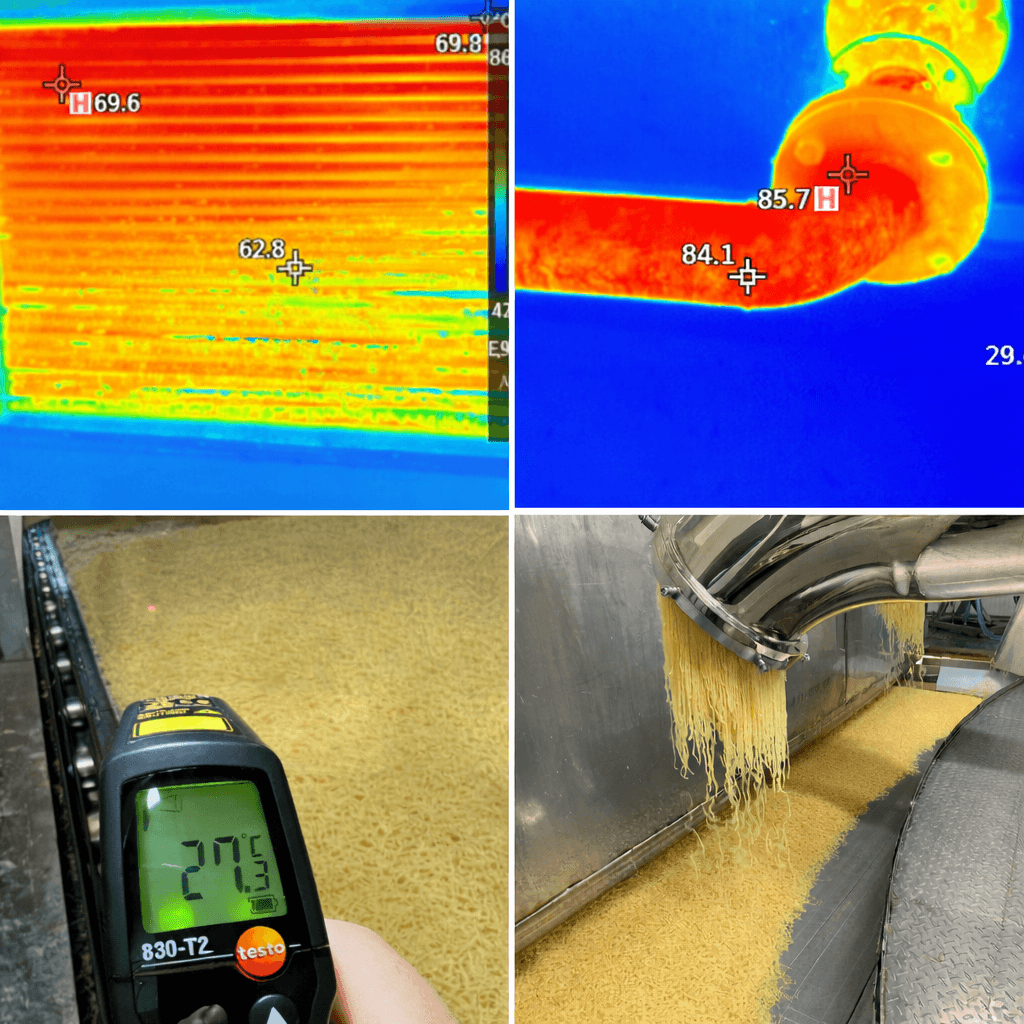
• the performance of zone heaters using a thermal imaging camera
• the mechanical condition of the drying belt, including chain guide, chain, mesh, and breaker
• the process and mechanical condition of the dehumidification system
This combination of measurements, thermal inspections, and mechanical checks provides a complete picture of the actual performance of the drying tunnel. This makes it possible to determine exactly where energy is being lost and where optimization is possible.
Small improvements, major benefits
In installations that run continuously, every detail matters. A slightly excessive airflow, a minor leak, contamination in a component, or an unnecessarily high temperature setpoint may seem limited at first glance. But in a gelatin drying tunnel operating day and night, these kinds of deviations can have a major impact on energy costs over the course of a year.
That is exactly why relatively small improvements can already deliver major benefits:
• lower energy costs
• more stable product quality
• less wear and fewer breakdowns
• higher installation reliability
• better insight into the actual performance of the drying process
In many cases, energy savings do not have to start with major investments. Often, the first gains can already be achieved by optimizing existing systems, improving process settings, and identifying technical deviations in time.
From inspection to concrete recommendations
For TEMA Process, a measurement or inspection is never an end in itself. The ultimate goal is to help customers move forward with clear conclusions and practical next steps.
That is why an inspection of a gelatin drying tunnel results in:
• an inspection report with an overview of the findings
• recommendations for improvements and energy-saving measures
In this way, we make it clear where the greatest opportunities lie and which actions will have the biggest effect. This may involve process optimization, technical improvements, maintenance measures, or replacement of specific components.
Globally available, locally applicable
TEMA Process carries out these measurements and inspections not only locally, but worldwide. Wherever the installation is located, our specialists can provide support in analyzing gelatin drying tunnels and identifying opportunities to save energy and improve performance.
In this way, we help producers all over the world make their installations more efficient, reliable, and future-proof.
Working together on more efficient gelatin drying tunnels
At TEMA Process, we believe that energy savings begin with a proper understanding of how an installation actually performs. By carrying out targeted measurements and in-depth technical inspections of gelatin drying tunnels, we help customers make better decisions — decisions that lead not only to reduced energy consumption, but also to a more stable and reliable process.
For installations that operate 24/7, this is especially important. Because that is exactly where small improvements make the difference.
Would you like to know where energy savings can be achieved in your drying process? Please feel free to contact us to discuss the possibilities. We are happy to support you worldwide with targeted measurements, technical inspections, and practical recommendations for a more efficient drying process.